HEPA filters: what the term means and what it does not
A HEPA filter is defined by 99.97% capture at 0.3 microns, yet EPA says consumer HEPA has no widely accepted definition. What the label can tell you.
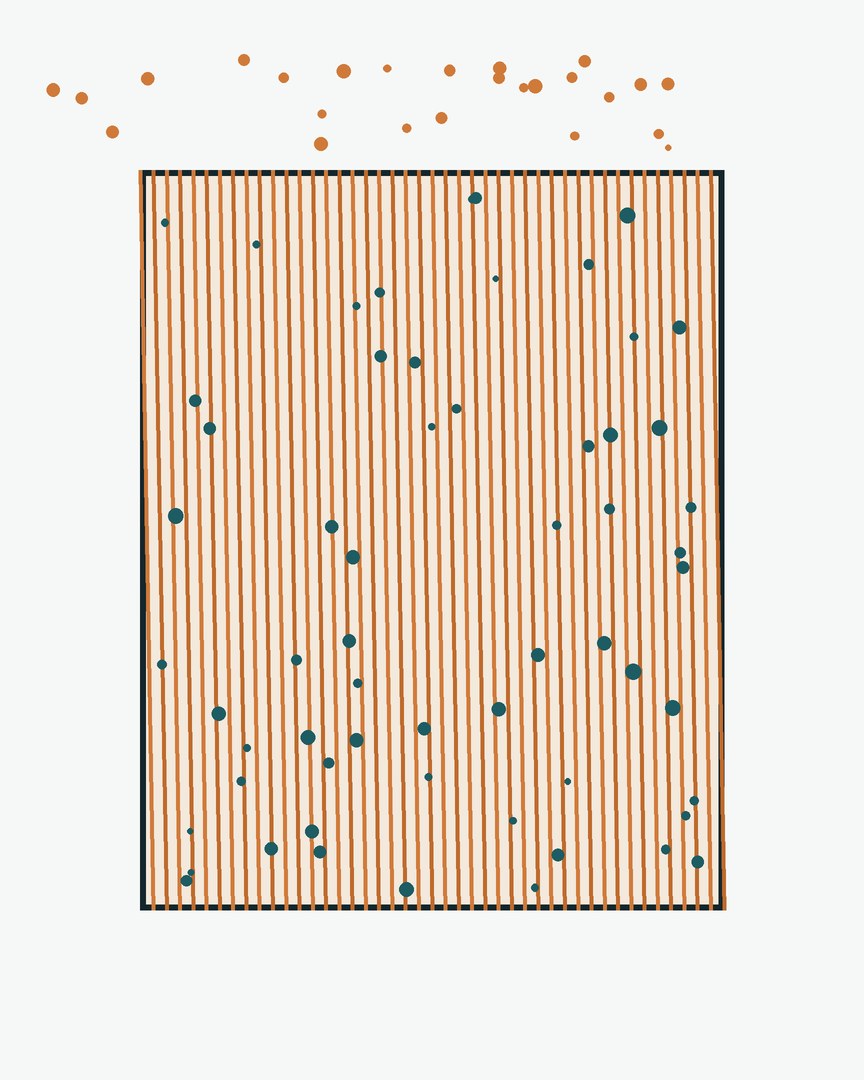
A HEPA filter is a pleated mechanical air filter defined by what it captures at one particle size: at least 99.97% at 0.3 microns. The name stands for high efficiency particulate air, and EPA’s explainer says the term is officially defined by the U.S. Department of Energy. That definition comes from an industrial setting, though. On a home air purifier the same four letters mean less: EPA’s technical summary says there is “no widely accepted definition of HEPA performance in consumer products.” EPA still describes these filters as offering the highest available particle removal of fibrous media in home air cleaners. The label just cannot promise a number on its own.
Where the 99.97% figure comes from
The most exact wording is in a Department of Energy handbook written for air cleaning in nuclear facilities. It says a HEPA filter is “a throwaway, extended-medium, dry-type filter with a rigid casing enclosing the full depth of the pleats, with a minimum efficiency of 99.97 percent when tested with an aerosol of 0.3-µm diameter test aerosol particles.”
Two details in that sentence matter to a household reader. The 99.97 percent is a tested minimum against a stated aerosol, not a description of the material. And the definition describes a rigid component with its pleats enclosed in a casing, written for nuclear facility air cleaning and not for consumer products. EPA’s page repeats the 99.97% figure and qualifies it with the word “theoretically”: this type of filter “can theoretically remove at least 99.97%” of airborne particles of 0.3 microns.
Why 0.3 microns is the size that matters
It is tempting to picture a HEPA filter as a sieve with holes just under 0.3 microns. A sieve would let everything smaller straight through, and EPA describes the opposite. Its Technical Summary says fibrous media filters remove particles “by capturing them on fibrous filter materials”, and the capture does not simply fall away as particles shrink. EPA says 0.3 microns “corresponds to the worst case; the most penetrating particle size (MPPS). Particles that are larger or smaller are trapped with even higher efficiency.” So the headline figure is set at the size the filter handles worst. The documents cited here do not set out the physics of how each size reaches a fiber.
The Department of Energy handbook places that weak spot in a band rather than at a single point: the minimum efficiency applies to “the most penetrating size particles, i.e., those ranging in size from 0.07 to 0.3 µm.”
One caution on the small end. EPA’s statement about smaller particles describes how HEPA media behaves. The Technical Summary also says that “none of these test standards measures the removal efficiency of particles smaller than 0.3 µm”, referring to the residential filter tests it reviews. A home filter’s performance below that size is generally not something its test result can tell you.
What HEPA means on a home air purifier
Here the household picture separates from the industrial one. EPA’s Technical Summary says three things together:
- Filters described as HEPA in residential air cleaners “are generally equivalent to MERV 16 and offer the highest available particle removal efficiency of fibrous media air filters for a wide range of particle sizes.”
- “There is no widely accepted definition of HEPA performance in consumer products.”
- Such filters are “unlikely to be equivalent in performance to HEPA-designated filter systems used in health care buildings and industrial processes, but still have very high removal efficiency (i.e., usually 99% or higher) for the reported particle sizes tested.”
So the fair reading of a HEPA label on a consumer unit is “very high removal efficiency, usually 99% or higher on the sizes tested, according to EPA”, and not “99.97% in this machine”. If a maker states the efficiency and the test size, that statement tells you more than the word HEPA does.
| Industrial definition (Department of Energy) | Home purifier labelled HEPA (EPA’s description) | |
|---|---|---|
| Stated efficiency | Minimum 99.97% | Usually 99% or higher on the sizes tested |
| Test particle | 0.3 microns | Varies with the test reported |
| Written definition | Yes, in the handbook, for that application | No widely accepted one, per EPA |
| Construction | Rigid casing enclosing the pleats | Varies by product |
True HEPA, HEPA-type and similar wording
Marketing has produced a small family of terms: HEPA, True HEPA, HEPA-type, HEPA-style. The EPA documents cited here give none of them a definition for consumer products.
An older EPA document did address the wording directly. The second edition of EPA’s residential air cleaners summary, revised in August 2009 and since superseded, said that higher efficiency pleated filters are “sometimes inaccurately called ‘high efficiency,’ ‘HEPA,’ or ‘HEPA-type’ filters”, that they are “similar in appearance to true HEPA filters, which have MERV values of 17 to 20, but use less efficient filter media.”
Read that as history, because the current third edition takes a different line and describes consumer HEPA filters as generally equivalent to MERV 16. Taken together, the two editions leave one practical rule: treat “HEPA-type” as a sign the filter is not claiming the 99.97% definition, and treat “HEPA” or “True HEPA” as a claim worth checking. Neither one is a measurement.
The MERV scale does not settle the question either. EPA notes that the efficiency it lists for HEPA is “not based on the MERV rating system.”
The filter is not the whole machine
A rated filter only cleans the air that passes through it. Air that slips around the edges goes back into the room as it came in. EPA’s Technical Summary describes the problem for loaded filters, warning of “increased bypass airflow around a clogged filter”, and says of filter frames that incorrect design or installation “can cause bypass airflow, which significantly decreases filter effectiveness.” The first statement covers furnace filters and portable air cleaners; the second comes from EPA’s discussion of HVAC installation. The EPA documents cited here give no leak rate for consumer housings.
This is why a machine-level number is more useful than a filter-level one. A CADR rating measures the filtered air the whole unit delivers, so it reflects the fan and the housing as well as the media. When comparing two units, CADR for the room size tells you more than which one has the more emphatic HEPA wording.
Airflow matters for a second reason. EPA says that an excessively loaded filter reduces the effectiveness of an air cleaner “because of reduced airflow through the filter and/or increased bypass airflow.” Replacing the filter on schedule is part of keeping the airflow the unit was built around.
What a HEPA filter does not remove
HEPA is a particle filter. EPA is plain about the limit: “Air-cleaning devices designed only to remove particles are incapable of controlling gases and some odors.” It gives tobacco smoke as an example, saying particle-only cleaners “will not remove all of the odorous compounds or the carcinogenic gas-phase pollutants from tobacco smoke.”
Removing gases takes a different stage, usually an activated carbon filter, with its own limits and its own replacement schedule.
Particles that have already settled are also out of reach. A filter acts only on what is airborne and carried to it, so dust on a shelf or in a carpet stays where it is until something disturbs it.
What the evidence shows about HEPA air cleaners
EPA’s Technical Summary says: “Most studies have reported reductions in PM exposures with the use of high-efficiency particulate air (HEPA) or other high-efficiency portable air cleaners on the order of approximately 50 percent or higher.” That is a statement about exposure to particles, and not about health.
Health results are weaker. EPA’s Guide to Air Cleaners in the Home says several studies with portable HEPA units have shown “small improvements in cardiovascular and respiratory health” that are “typically small and not always noticeable to the individual”, though it adds they may be measurable by health professionals. On allergy and asthma, it reports improvement in one or more symptoms in multiple portable HEPA studies, but adds that the studies “do not always show major improvements, and they do not show improvements in all symptoms.” A lower particle count in a room is not the same thing as a health benefit, and no air purifier cures asthma or any other condition. Anyone managing a health condition should talk to a clinician. On infections, a 2021 systematic review by Hammond and colleagues in PLoS One reported: “No studies were found investigating the effects of air filters on the incidence of respiratory infections.” More is in the guide to air purifiers and viruses.
EPA also says that filtration “does not replace the need to control pollutants and ventilate”, and that it does not certify or recommend specific brands or models.
How to read a HEPA claim before buying
- Look for a stated efficiency and the particle size it applies to. A figure with no size attached says little.
- Treat “HEPA-type”, “HEPA-style” or “HEPA-like” as wording that does not claim the 99.97% definition.
- Compare units by CADR for the room, not by the adjective in front of HEPA.
- Check whether the unit also has a gas stage, if smells or chemicals are the reason for buying.
- Find the replacement interval and filter availability before buying, because the filter is what keeps the unit working.
Common questions
What does HEPA stand for?
High efficiency particulate air. EPA notes that the term is officially defined by the U.S. Department of Energy. That official definition was written for a different setting from a living room, which is why the words on a retail box deserve a second look.
Is True HEPA better than HEPA?
EPA's current documents cited here do not define 'True HEPA' for consumer products; an older, superseded EPA edition used 'true HEPA' for filters with MERV values of 17 to 20. EPA now says consumer HEPA itself lacks a widely accepted definition, so an added adjective cannot settle anything. Look for the tested efficiency, the particle size it was tested at, and a CADR for the whole machine.
Do HEPA filters remove smells?
Not reliably. A HEPA filter is built to catch particles, and EPA says devices designed only to remove particles are incapable of controlling gases and some odors. Smells that come from gases need a sorbent stage such as activated carbon, and even that has limits.
Can I wash a HEPA filter?
Only if the maker of that filter says so in writing. The Department of Energy definition, written for nuclear facilities, calls a HEPA filter a throwaway filter, and none of the EPA documents consulted here report test results for a washed one. If the manual gives no washing instruction, replace the filter instead.
Can I put a HEPA filter in my furnace?
Check first. EPA warns that not all HVAC fans can handle high-efficiency filters without affecting performance, and says a trained professional may need to modify a system to take a higher efficiency filter. Ask an HVAC technician before fitting anything beyond what your system is made for.
Sources
- U.S. EPA: What is a HEPA filter?
- U.S. EPA: Residential Air Cleaners, A Technical Summary, 3rd edition
- U.S. Department of Energy: DOE-HDBK-1169-2022, Air Cleaning Systems in DOE Nuclear Facilities
- U.S. EPA: Guide to Air Cleaners in the Home, 2nd edition
- U.S. EPA (archived): Residential Air Cleaners, Second Edition
Read next
When and how to replace air purifier filters
Air purifier filter replacement follows the maker's interval, not a universal number. What a loaded filter does, why carbon gives no warning, how to swap it.
Activated carbon filters: what they remove and when they stop
An activated carbon filter adsorbs some gases and odors, misses others and fills up without warning. What EPA and test data say about carbon in air purifiers.
What size air purifier for your room: the math, worked out
Air purifier room size in one sum: a smoke CADR of two-thirds of the floor area. Worked examples, air changes per hour, high ceilings, smoke and open plans.
CADR ratings explained: what the three numbers measure
CADR is the clean air a portable purifier delivers, in cfm, tested on smoke, dust and pollen at top speed. What it measures, what it misses, how to read it.
Air purifier for wildfire smoke: sizing, setup and limits
How to choose an air purifier for wildfire smoke: EPA and AHAM sizing, a clean room, running it on high, what carbon adds, and what the data does not show.